How to Protect My Fine Art Photography Archive After My Death
Blake Morrison
Author
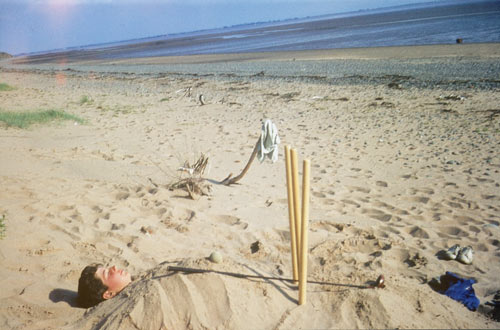
I tell myself I've never endemic a camera, but that doesn't square with a memory of being given one every bit a altogether present in my teens, and of a losing struggle with low-cal, shade, discontinuity, distance, angle, focus. Cameras were more demanding so, and I hadn't the patience. Other people did it better.
Not to the lowest degree, to begin with, my begetter. A stranger looking through my childhood photos might deduce a) that we were perpetually on holiday in north Wales, and b) that my male parent never accompanied u.s.a.. But he wasn't absent-minded, but hiding backside the lens of his Nikon. About of his snaps were taken without us noticing. Simply a few were play a trick on photos, such equally the one with my mother, sis and me arranged higher up each other on a steep hill, to wait similar acrobats standing on each other's shoulders.
Despite their playfulness, my chief feeling when I look at those photos is sadness: that most of the people in them are now expressionless; that the times they commemorate tin can't be retrieved. It'south sentimental, I know: time passes; the moment goes fifty-fifty equally the shutter clicks. But those photographic images are a source of sorrow, whereas the images in my caput are not. Larkin has a verse form about how memories "link us to our losses" by showing us "what we have as information technology in one case was,/Blindingly undiminished, just as though/By acting differently we could have kept it and then." That's the effect old photos take on me. Worse, though, would be to have none at all. My favourite photograph is i of my female parent in pigtails as a child, an epitome unknown to me until a few years ago, after her death, when a cousin sent it. The primeval image I had of her till then was a graduation photo, taken in Dublin. There were none of her large family unit, either. I felt shut out from her past, and the lack of pictures was role of the reason.
My male parent's childhood was heavily documented past comparison, and he was scrupulous near documenting his children's, first in tiny black-and-white prints, then with colour transparencies, which were looked at through a viewfinder or (at the annual Christmas slide show put on for my long-suffering cousins) on a white screen. He likewise had a cine camera, and I sometimes experience guilty that my own children, unlike me, have no moving images of themselves to look back on. Why my married woman and I never bought a video photographic camera, I don't know (laziness? expense?). But she at least has been diligent down the years, with box cameras, Polaroids, disposables and (most recently) a digital Canon. The results have been pasted in albums and dated, and every and so often I become them out to meet what we got upwards to. These, too, make me tearful.
I at present have a photo binder on my computer, for emailed pictures sent by friends and family. More to the betoken, I own an iPhone and accept begun to take snaps. My shots from the Shard at dark were disappointing. And it's too late for me to compete with the poet Hugo Williams, who has been taking his camera to parties and volume launches for decades and who must by now have one of the great literary photograph-archives of our time. But tentatively, decades too late, I take fabricated a kickoff.
Mary McCartney
Lensman
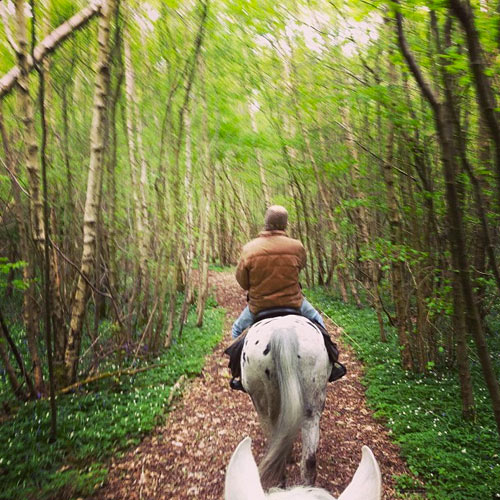
I accept a vivid early memory of going to a darkroom with my mum. I would see her taking photos a lot, though she didn't do much printing. But she took me in that location ane mean solar day and I think seeing a bare page put into a chemical bath and becoming a photograph. We didn't really have any of her pictures around the business firm, but at that place was a Jacques-Henri Lartigue, and an Edward S Curtis portait of some native Americans. Mum grew upwardly in New York and she got into photography later on seeing the famous Family unit of Man exhibition at the Museum of Modern Art, curated by Edward Steichen. She mentioned it often; my mum and dad discussed photography a lot.
Because I grew upwards around it, I causeless everyone could accept pictures. Now, I realise that not everyone has the eye. It'south true that every kid tin accept pictures that you could use or publish, and at that place are a lot more being documented. Simply information technology's yet difficult to do a proper shoot, or go into depth; information technology takes a lot of time and attending. I still recall in picture: I always have. If I take an image that I really similar, it feels more real if information technology'due south defenseless on film; if I've shot information technology digitally, I feel it could just disappear. The confusing matter for me is how many different means at that place are of taking photos. I accept a fair amount on my iPhone, quite a few on my 35mm Leica, plus on my digital photographic camera, and I have a Polaroid, as well. When I'm going on an assignment, I never know which cameras to take. I'm embarrassed to say that my main camera is my iPhone. I'm on Instagram then I tin follow friends; I like how firsthand it is. I upload with filters sometimes; I'm not that purist near information technology. In the by, you'd pick a certain type of film for a certain expect, and today's filters are a similar concept: the modern version of choosing the correct mood. But if in that location'south absolutely stunning light, and a moving-picture show hasn't needed a filter, I e'er do #nofilter.
Family pictures are the most precious. I have a set of prints I carry effectually in my wallet of my kids, my husband and my parents. I await at those rather than writing a diary: they're very evocative and textural and emotional, and have you dorsum to specific moments. I change them every so oftentimes, after they get worn out. The picture I carry of my parents is a piddling erstwhile colour print of them hugging in the 70s, which is sweet. The one of my married man and me was taken in a photobooth a friend rented for a birthday party. I honey the old-fashioned booths where y'all get iv different shots; they feel unique because yous've got the simply version that will ever be. I likewise have a great photobooth strip of my son when he was actually immature. He'south crying at the offset – then in the adjacent photo my hand's in there, giving him an water ice-foam.
Steve Pyke
Photographer
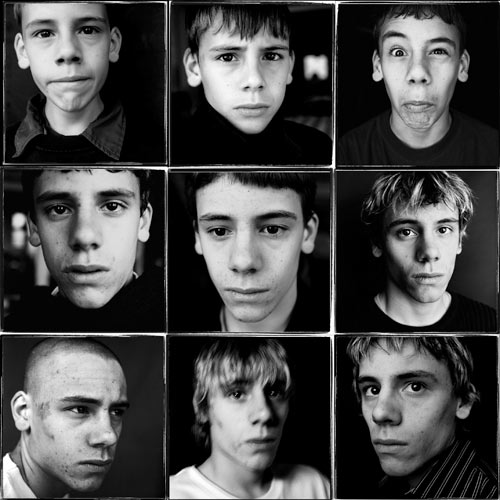
I grew upwardly in Leicester in the 60s. The starting time time I became enthralled past photography was when my mum got a subscription to Life magazine: the Apollo 8 cover from December 1968 was particularly dear to me. I never wanted to be a railroad train driver, ever an astronaut. I went on to piece of work for Life, and my astronauts series concluded up in its pages in 1999/2000, so I came total circle.
I've been photographing my children since they were born. I don't photo them every day at present, but every few months: Jack's at present 26 and Duncan's 21. It came about in the 1980s: I was making Super eight films and working on a motion picture with Peter Greenaway that photographed things over fourth dimension. David Attenborough did it first, with a expressionless mouse that eventually had maggots in it. I thought: what an amazing affair to practice with a human being, moving-picture show someone on Super eight from birth to expiry. When Jack was 20 minutes erstwhile, I made my starting time image of him, with the idea that the death at the end of the cycle would be mine, not his. I as well photograph my girl Lola Rae, who is six. She plays to the camera and is more than enlightened of herself. Now I've started to browse in the photos to make stop-motion animations.
I store all my images in impress form, but besides as digital scans on hard drives. I borrow my girlfriend's digital camera and iPhone sometimes, just I oasis't ever bought one considering I shoot with my Rolleiflex. It'southward hard to exercise it any other way at present. I've likewise been collecting photography prints since 1980, and have an eclectic drove: a Brassai, an Enrique Mezenides, a Diane Arbus, an Eggleston, and a couple of Nan Goldins, because I was a part of that time and place here in New York. I have a wall of photographs in my studio, for inspiration and influence, that I alter sporadically (pictured at the top of the article). The balance of the walls are covered with my ain portraits of people similar Joe Strummer, John Waters, Robert Johnson.
I've shot millions of images so information technology's hard to pull something out that's symbolic. But there is a photo that ways a lot to me hanging in my studio. I photographed it on the first roll I ever took at Billy Smart'due south Circus in Battersea in the early on 1980s. Days before, a friend had taken me to a pub on Tottenham Court Road. He had a Pentax and he showed me how to use it, then gave me two rolls of film. I photographed circuses, fairgrounds, bars. The prototype is a woman lying down, balancing a table on her feet. Information technology's her job, only there'southward a whole sexuality attribute to it, as well. Photography and surrealism are so linked. It'due south a crazy manner to earn a living, on your back like that.
Grayson Perry
Artist
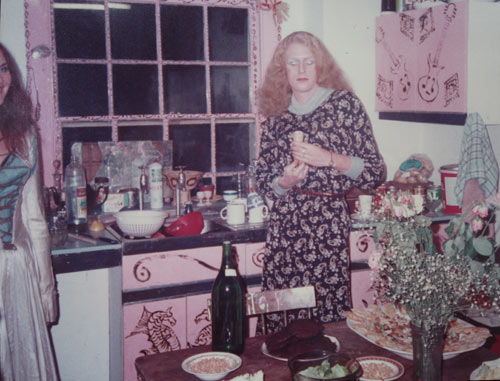
When I was about five, my mother made a bonfire in the dorsum garden and burned a suitcase full of family unit photos taken by my father. He had been a keen photographer with his own dark room. I don't know why she burned them, only it coincided with them getting divorced and my stepfather moving in.
For the rest of my childhood, no one in the family possessed a photographic camera, and then I have very few photographs of myself before art college. Family snaps are somehow celebratory of the expert times so there was little motivation to record our lives. As shortly as I could afford it, I bought a clunky Russian Zenith SLR. It was bulky and manual and I had little spare cash for motion-picture show, so I took few snaps at offset. Some of my most precious and almost naff are the earliest images of myself in women's clothes, staring into the lens, nervously waiting for the cocky-timer to go off. Transvestites have a very symbiotic relationship with the camera. Nosotros used to joke at tranny events that we should seek Kodak sponsorship.
I was never very good at the technical side, and take few expert photographs of my early work, an omission I came to regret when researching my get-go retrospective show. I had put on whole exhibitions in the 1980s without taking a single photo. Nowadays, my dealer will commission high-quality photographs as a matter of grade.
Before long later meaty automatic cameras became available I started taking a lot of snaps. This was a addiction I kept up until adequately recently, specially when my daughter was young. I used to put them in albums religiously, until I saw a TV programme where a curator from the Museum of Moving picture and Photography said those gluey, clingfilm-mode albums are terrible for the prints and you lot should keep them in a shoebox. Which I did, unedited, for years until I realised we never looked at them. So my girl and I spent a calendar week going through thousands and sorted the all-time into a serial of albums.
Since the appearance of digital photography, I have taken fewer and fewer photos for fun, but hugely more for enquiry, or to record my work, or outfits. I take a few to record our ageing. I will proceed holiday and return with merely a dozen snaps. I don't know whether this is because of age, laziness or the feeling that photography has become a torrent of cliches. The cameraphone has made the woods of glowing screens ubiquitous in museums, galleries and at events. Possibly I'm a snob, only it's put me off photography.
Katie Mitchell
Theatre managing director
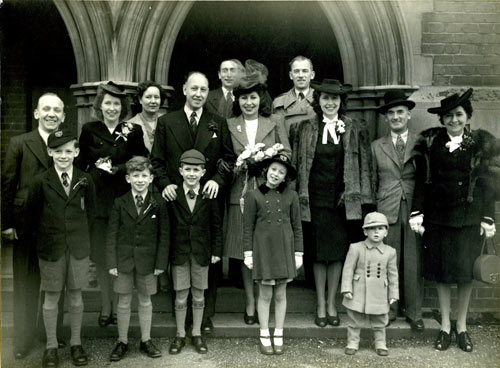
My father always took photographs of our summer holidays and printed the film into slides. He used a Japanese camera, a 35mm Canon. Nosotros had family slide shows every winter. There was a white plastic screen that had to be pulled up out of its cylindrical container, and nosotros had to exist careful not to go gluey fingers on the negatives. There were framed photographs of us around the house and my favourite was a apparently wooden frame around a color movie of me, with the sunday hitting the lens then information technology created a halo effectually my smiling head. My dad also taught my brother and me how to make pinhole cameras when I was nigh ten.
My uncle Richard took photographs for the Leicester Mercury, specialising in sports photography and popular concerts like the Beatles, and so the house was also littered with his shots. My brother started taking black-and-white images when he was at prep school and later went into photography professionally. My outset experience of a dark room was with him in my early 20s. The magic of the prototype emerging on to the white photographic paper in the thick red gloom was bewitching, and I loved the style the images were hung upwards on a washing line.
When I went to university, my father gave me his old Canon and I call up the complexity of all the settings, how hard information technology was to load and the importance of caring for it. Later, equally I became more interested in film, my dad bought me a Super eight photographic camera and I recall the delight when you started filming and the camera whirred until you pressed stop. Now I utilize either the new digital camera my mum bought me when I had my daughter, or my iPhone. I shop my photographs on my reckoner and rarely print them. In the kickoff 2 years of my daughter'southward life, I printed all the photographs of her and put them into albums, and had some framed. But they looked unlike from my childhood photographs. It's the texture: I miss the grain of the original print.
It'due south the old family photographs from the 1920s onwards that I honey the well-nigh. When I am with either of my parents, I am always rummaging effectually in their former collections. Before my granny died, I got her to tell me who all the people were in the photographs in her firm, and I carefully wrote on the dorsum of each ane. I'm at present doing the same with my mum's old photographs. I am particularly addicted of a picture of my mother standing with her mother and property out her hand to feed a pigeon whose wings are blurred. It must be the 1930s. And in that location is a tiny, tiny photograph of my granny'southward family on my dad'southward side, taken on the Kennington Road in London in the 1920s. My great grandad is seated cradling Arthur, one of his sons, who looks as if he has polio, and the rest of the family and friends are crowded around, almost 30 people.
These tiny images, sometimes only 3in x 1in, with their curled edges, are the simply fashion of touching people in my past. Like many people, my family was broken up by time, events, place and then on, and looking at these is a way of putting the pieces of my past together, like a jigsaw. When I am doing this, I often think of TS Eliot's Eastward Coker:
'In that location is a time for the evening under starlight,
A time for the evening nether lamplight
(The evening with the photograph album).'
Sean O'Hagan
Photography critic
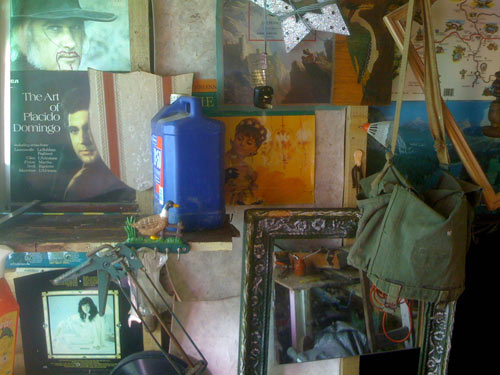
I retrieve a Kodak Instamatic that appeared every time we went on holiday or had a family gathering. The rest of the time it resided in the "everything drawer" in the kitchen, alongside lightbulbs, batteries, pieces of string, mark pens, dress pegs and all the other detritus of family life. The idea that information technology could exist taken out, loaded up with cheap film and used to record my everyday life never occurred to me. This is now a source of deep regret.
I lived through the onset of the Troubles in Armagh, and it strikes me at present that I could have been a kind of anti-Ed Ruscha. He photographed every building on Sunset Strip. I could have photographed every bombed building on Scotch Street. What a serial that would take been.
I moved to London simply in time for punk, but I didn't own a camera and so, either, nor did I always think of buying one. For a time, I shared a apartment with an Australian girl who had a Pentax (or peradventure a Nikon), which, as I recall, she used a lot. When she departed for home after one likewise many long London winters, she took all her snapshots with her. Somewhere downwards nether, there is a treasure trove of photographs of me and my friends in various states of chemical busted in our dilapidated leather jackets, torn Levi'due south and Ramones T-shirts.
Once, while working for the NME in the tardily 80s, I took some photographs to accompany a feature on Everything But the Girl in Moscow. I used colour slide film, unwittingly. That's how accomplished I was. The pictures ran, though. I filled a whole page: Ben and Tracy beneath a giant statue of Lenin. It remains a source of some pride: my i brush with practical photography. Though I write about photography for a living, I did not own a camera until recently. My first was a Pentax Omnio digital compact – a present from my married woman. It's a nifty trivial photographic camera, and already an ancient relic of some other time. I now own a Fuji X10, which I use as a visual diary. I effort not to shoot equally much as I used to because so many great photographers have told me that the real editing takes place as you are shooting. I accept never printed a digital photograph. They are stored on my hard disk drive in their hundreds, possibly thousands. This fills me with a vague anxiety.
I can see at present that I shoot certain things over and over: landscapes whizzing by from moving trains; people dozing on the tube; things scrawled on walls (though not graffiti or graffiti tags); the tops of copse against the sky. I basically shoot the kind of photography I like. I think photographs should be intimate. And everyday. And luminous. That'south a tall gild, but the all-time photographers pull it off all the time. When my male parent was very ill a few years ago, and once more just later he died, I photographed the interior of his garden shed on my telephone and digital photographic camera. The images, together and separately, feel like a portrait of him somehow – a portrait of the inside of his head and all the stuff he had collected there. For me, they possess a meaning that many of my other photographs do not. Something to do with time and mortality and memory, all the things Roland Barthes wrote near in Photographic camera Lucida, and which photography seems to evoke like no other art grade because of its very nature – the separate 2nd already gone. At some bespeak, I will put some words to them, because that is what I exercise. I'm a writer, not a lensman. But every fourth dimension I meet a photograph that surprises me, I wish – for a split second – it was the other fashion effectually.
Jemima Kiss
Technology writer
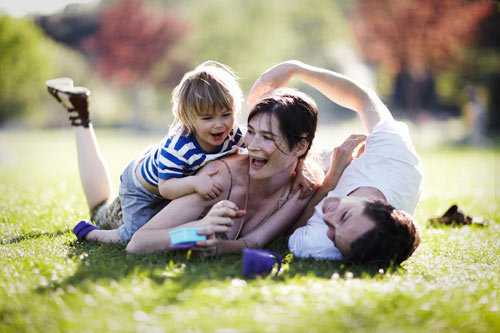
Somewhere upstairs in my partner Will's cold, muddied office next to the ambulation cupboard, at that place's a collection of dusty, battered difficult drives. They are non well-loved, and occasionally go used as doorstops. However hidden inside is an invaluable role of our family history – our collection of photos. Will is a photographer, and though in that location have been occasions where nosotros have sifted through photos and even printed a couple out, the sheer, overwhelming volume of pictures he has taken over the years has made it incommunicable even to brainstorm to manage or access this drove. Information technology's a source of abiding frustration for my mother-in-law, who regularly bemoans the fact that her professional photographer son is unable to provide her with printed images of her grandchildren. He takes up to 80Gb of photos per shoot and estimates he has one-half a million photos. Information technology's insurmountable.
We recently pulled out some photographs for our wedding invitation, discovering swaths of images we hadn't seen for years, or ever. I wondered if in that location is a point – similar to Dunbar'due south Law – beyond which nosotros are unable to process volumes of information.
Combined with human incompetence and the chaos of child-rearing, the inaccessibility of our visual memory bank has become a existent os of contention. Terminal jump I spent 3 evenings editing and sorting (with no minor amount of obsessive satisfaction, I should add) a few m photos of us all, organising by result and pulling the best into a shortlist folder. We moved house, and the hard drive disappeared. Possibly lost, maybe wiped. In the digital world, easy come, piece of cake go.
If we had had only 10 pictures in the earth, would we take been more careful with them? They would each be meticulously stored, labelled, backed up and printed out in beautiful frames – and probably in my mother-in-law's firm, too.
It wasn't ever this way. I notwithstanding have a shoe box of prints from my babyhood, and crates of my dad'southward slides that I've been gradually scanning to eventually share online. Family unit cameras – my grandmother'southward Brownie Vecta, my dad'southward SLR – were precious, hallowed objects, not for our grubby hands. The relatively modest number of photos in the family collection from when I was a child meant that many of them came to represent powerful, emotional links to our past: to favourite holidays, to my childhood home (now demolished). Subsequently, with the death of my male parent, they took on a rather cruel disconnect to the present world; he seems so vital and live in a coincidental moment caught and printed on a random piece of photographic paper, yet he is no longer hither. What'southward next, then, for this photographic, digital overload? Nosotros are even so early into our adaptation to the digital globe, and unsophisticated when it comes to managing all this material. We demand to be more than selective in what we choose to photograph and what we cull to continue. If it's a bad photo, or only ane of the 10 you shot is whatsoever good, but go along the all-time 1. Delete is your friend.
But the problem also needs technological recognition. Photo storage needs to exist more automatic, and photograph-viewing software should also help usa more than. It can learn which photos we view about often, and let the poor photos recede automatically. Software could summarise the 10 all-time photos nosotros've taken that calendar month, and put them somewhere special. It could place indistinguishable photos and suggest the one to keep. Don't back up all 3,000, just the 30 y'all really treasure. All we need is some bright spark to fix the problem.
Louise Wilson
Artist
I got into photography at art college. I borrowed a 35mm camera, and would go in the dark room for hours, practising how to load the neg on to the spools.
Only I merely bought my starting time camera later: a Mamiya C330 with a twin lens. My sister Jane and I would make our own large-scale prints, almost five metres wide, with an enlarger that nosotros had to tilt on its side to make the projections big enough. We would bring garden troughs into the dark room, whorl these massive sheets in h2o, then in programmer, and so ready them, before running each sheet nether h2o for hours. We got weekend access and I would stay in there till all hours.
I utilize a digital photographic camera, and an iPhone: you can do little furnishings, and I love apps where you tin shoot grainy, black-and-white movies. Nosotros did a big number for the ICA in London, in 2011, where we shot a recreation of the Odessa step scene from Battleship Potemkin on my iPhone. The idea was that it looked really lo-fi, that we just captured it on the fly with loads of volunteers, which we did. The curator Norman Rosenthal was there that day, which was serendipitous: he played the wailing woman that gets shot, and drag queen Jonny Woo was the female parent pushing the pram down the steps.
Information technology's interesting to see how playful my nephew is at six, shooting his own movies. The next generation have a consummate familiarity with documenting themselves and their surroundings in a way we just didn't. Photography has entered such a democratic sphere now, with the digital realm open up to all. Younger people edit their ain movies, set their own events, and there'southward a existent confidence – it's totally entered their language. I often take him to exhibitions and he loves sitting cross-legged on the floor and watching video art; his generation have such an empathy with that kind of piece of work.
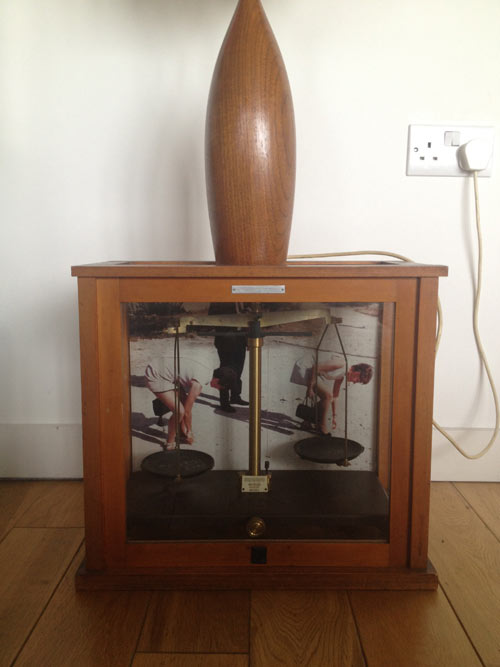
My father had a dark room before Jane and I were born. A few years ago, we institute a really interesting image he'd taken and turned it into a sculpture (pictured above). It's a picture of my female parent and a friend of hers bending downward to pick up shells on the beach, looking very 60s. Their posture mirrors each other, and in that location's a man in the middle holding a camera, and these cute long shadows from a depression, tardily afternoon sun. Jane and I put his photo behind a set of former-fashioned weighing scales. The scales reflect the residuum, the way the women seem on the same plain. Today, information technology'south in my house with a lampshade on meridian of it. I've never talked to my dad about his photography, merely this curious construction always reminds me of him, and where my dearest of the nighttime room came from.
Adrian Searle
Fine art critic
When I wait at myself as a child, it always looks similar someone else's retentiveness rather than a childhood I call back for myself. When I run across a photograph of my female parent, I barely recognise her. This saddens me, and says less about the photograph than it does almost memory and my childhood feel. I also accept a number of family albums and boxes stuffed with pictures, some well over a century old. I keep them cool and in the dark, and rarely await at them.
I was given a camera in my early teens, and promptly broke it. At art higher I managed to work out the mysteries of the SLR and light-meter, only autonomously from documenting fine art, I have usually been without a camera. There are years and years of my life, places I accept been, friends and lovers, my daughter growing up, fish I have caught, rooms I have lived in, for which I take few visual records. A shot of my daughter, aged four, by the creative person and picture editor Bruce Bernard, who taught me a keen bargain nearly how to look at photographs, is a small talisman, and sits past my bed. Our relationships to detail photographs – rather than photography in full general – can be very complex. Affect is complicated, memory is complicated.
Digital photography, a cameraphone and a slightly less rackety life has made things easier, if not more organised. I used to draw and scribble my mode circular exhibitions. Now I have photographs all the time, mostly of shows and artworks, which I employ for quick reference – though the drawings in my notebooks mean more to me. I also have the aforementioned sort of snaps anyone else might have: in that location's you on the bed, here's me in the sunshine. What city was it? The photographs pile upwards in iPhoto, which always wants me to catalogue them, but I resist.
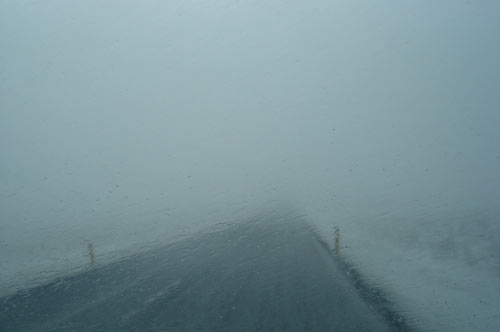
Some other favourite is as well my desktop screensaver (pictured in a higher place). Shot with my phone while trapped in a car during a blizzard in Iceland, with the artist Roni Horn, it's the view through the windshield: a view of emptiness filled with grey green weather. I keep thinking information technology'southward Roni's picture, even though I shot it. I dream my manner in and out of images in photography books. I day it might be John Davies's England, another information technology could be Michael Schmidt'south Berlin, William Eggleston's Memphis or Anders Petersen'southward Café Lehmitz in Hamburg.
On my wall are a number of images by Juergen Teller. There's besides a photo by Jemima Stehli of me wearing a suit, watching her undress. Holding the shutter-release, I am photographing myself watching her. Ane of Teller's portraits of me, looking mad, was pasted to the wall in his contempo ICA exhibition. It was right down at floor level; you could requite information technology a quick kicking as y'all passed. With the years, the photographic camera has encouraged me to become an exhibitionist.
Photographs: Steve Pyke; Blake Morrison; Mary McCartney; Grayson Perry; Katie Mitchell; Sean O'Hagan; Will Whipple; Jane and Louise Wilson; Adrian Searle
0 Response to "How to Protect My Fine Art Photography Archive After My Death"
Enregistrer un commentaire