Pavlov Approach to Behavior Modification Using Mask to Scare Baby
What you'll learn to do: explain central principles of behaviorism and cognitive psychology

Is all beliefs learned from the environment? Should psychology, as science, focus on observable behavior—the result of stimulus-response, every bit opposed to internal events like thinking and emotion? Is there piffling difference betwixt the learning that takes identify in humans and that in other animals? These are types of questions considered by behaviorists, which we'll acquire more about in this section. We'll likewise consider cognitive theories, which examine the construction of idea processes, including remembering, problem-solving, and determination-making, from childhood through adolescence to adulthood.
Learning outcomes
- Depict the principles of classical conditioning
- Describe the principles of operant conditioning
- Describe social learning theory
- Describe Piaget'due south theory of cerebral development
- Draw information processing approaches to cerebral development
Exploring Behavior
The Behavioral Perspective: A Focus on Observable Behavior
The behavioral perspective is the psychological arroyo that suggests that the keys to understanding development are appreciable behavior and external stimuli in the environment. Behaviorism is a theory of learning, and learning theories focus on how we reply to events or stimuli rather than emphasizing internal factors that motivate our actions. These theories provide an explanation of how experience tin modify what we do.
Behaviorism emerged early on in the 20th century and became a major force in American psychology. Championed by psychologists such as John B. Watson (1878–1958) and B. F. Skinner (1904–1990), behaviorism rejected any reference to mind and viewed overt and observable behavior every bit the proper subject matter of psychology. Through the scientific report of behavior, it was hoped that laws of learning could be derived that would promote the prediction and control of behavior. Russian physiologist Ivan Pavlov (1849–1936) influenced early on behaviorism in America. His work on conditioned learning, popularly referred to equally classical conditioning, provided back up for the notion that learning and behavior were controlled by events in the surroundings and could be explained with no reference to mind or consciousness (Fancher, 1987).
Classical Conditioning and Emotional Responses
Classical conditioning theory helps us to understand how our responses to i state of affairs go attached to new situations. For example, a smell might remind u.s. of a time when nosotros were a kid. If you went to a new cafe with the aforementioned smell equally your simple cafeteria, it might evoke the feelings you had when you were in school. Or a song on the radio might remind you of a memorable evening you spent with your first true love. Or, if you hear your unabridged proper name (Isaiah Wilmington Brewer, for instance) called equally y'all walk beyond the stage to get your diploma and it makes you tense because it reminds y'all of how your father used to use your full proper noun when he was mad at yous, then you've been classically conditioned.
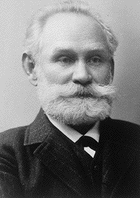
Figure 1. Ivan Pavlov
Classical workout explains how we develop many of our emotional responses to people or events or our "gut level" reactions to situations. New situations may bring about an sometime response because the two have become continued. Attachments form in this way. Addictions are afflicted by classical workout, every bit anyone who'due south tried to quit smoking can tell y'all. When you lot try to quit, everything that was associated with smoking makes you crave a cigarette.
Pavlov and Classical Conditioning
Ivan Pavlov (1849–1936) was a Russian physiologist interested in studying digestion. Every bit he recorded the corporeality of salivation his laboratory dogs produced as they ate, he noticed that they really began to salivate earlier the food arrived as the researcher walked downwards the hall and toward the muzzle. "This," he thought, "is not natural!" 1 would expect a dog to automatically salivate when the food hit their palate, merely before the food comes? Of course, what happened is that the dogs knew that the food was coming considering they had learned to associate the footsteps with the nutrient. The keyword here is "learned."
A learned response is called a "conditioned" response. Pavlov began to experiment with this "psychic" reflex. He began to ring a bell, for instance, prior to introducing the food. Sure enough, later making this connectedness several times, the dogs could exist made to salivate to the sound of a bell. One time the bell had become an result to which the dogs had learned to salivate, it was chosen a conditioned stimulus. The human action of salivating to a bell was a response that had also been learned, now termed in Pavlov'due south jargon, a conditioned response. Discover that the response, salivation, is the same whether information technology is conditioned or unconditioned (unlearned or natural). What inverse is the stimulus to which the dog salivates. One is natural (unconditioned) and one is learned (conditioned).

Figure 2. Before conditioning, an unconditioned stimulus (food) produces an unconditioned response (salivation), and a neutral stimulus (bell) does not produce a response. During conditioning, the unconditioned stimulus (nutrient) is presented repeatedly simply afterwards the presentation of the neutral stimulus (bell). Later on workout, the neutral stimulus alone produces a conditioned response (salivation), thus becoming a conditioned stimulus.
Picket It
View the following video to learn more about Pavlov and his dogs:
Watson and Behaviorism
Let's recollect about how classical conditioning is used on people, and not merely with dogs. Ane of the most widespread applications of classical workout principles was brought to us by the psychologist, John B. Watson. Watson proposed that the procedure of classical conditioning (based on Pavlov's observations) was able to explicate all aspects of human psychology. He established the psychological schoolhouse of behaviorism, after doing research on animal behavior. This school was extremely influential in the centre of the 20th century when B.F. Skinner developed it further.
Watson believed that most of our fears and other emotional responses are classically conditioned. He gained a good deal of popularity in the 1920s with his expert advice on parenting offered to the public. He believed that parents could be taught to assistance shape their children's behavior and tried to demonstrate the power of classical conditioning with his famous experiment with an eighteen-month-quondam boy named "Footling Albert." Watson sat Albert down and introduced a multifariousness of seemingly scary objects to him: a burning piece of paper, a white rat, etc. Simply Albert remained curious and reached for all of these things. Watson knew that 1 of our only inborn fears is the fearfulness of loud noises and so he proceeded to make a loud noise each time he introduced i of Albert'south favorites, a white rat. After hearing the loud noise several times paired with the rat, Albert shortly came to fear the rat and began to cry when it was introduced.
Watson filmed this experiment for posterity and used it to demonstrate that he could assist parents achieve any outcomes they desired if they would merely follow his advice. Watson wrote columns in newspapers and in magazines and gained a lot of popularity among parents eager to use science to household order. Parenting advice was not the legacy Watson left us, still; where he really made his bear on was in advertising. After Watson left academia, he went into the globe of business concern and showed companies how to tie something that brings about a natural positive feeling to their products to enhance sales. Thus the union of sex activity and advertizement!
Link to Learning: Piffling Albert
View scenes from John Watson's experiment in which Lilliputian Albert was conditioned to respond in fear to furry objects. Equally you lot watch the video, look closely at Picayune Albert's reactions and the manner in which Watson and Rayner nowadays the stimuli earlier and after conditioning. In the experiment with Trivial Albert, cheque to see if you tin can place the conditioned and unconditioned stimuli and responses: identify the unconditioned stimulus, the unconditioned response, and, after workout, the conditioned stimulus and the conditioned response.
Try Information technology
Operant Workout
Now we plough to the second type of associative learning, operant conditioning. In operant conditioning, organisms learn to associate a behavior and its outcome (Tabular array 1). A pleasant consequence makes that behavior more likely to exist repeated in the future. For example, Spirit, a dolphin at the National Aquarium in Baltimore, does a flip in the air when her trainer blows a whistle. The upshot is that she gets a fish.
Psychologist B. F. Skinner saw that classical conditioning is limited to existing behaviors that are reflexively elicited, and it doesn't account for new behaviors such as riding a wheel. He proposed a theory nigh how such behaviors come about. Skinner believed that beliefs is motivated by the consequences we receive for the behavior: the reinforcements and punishments. His thought that learning is the result of consequences is based on the constabulary of effect, which was first proposed by psychologist Edward Thorndike. According to the law of consequence, behaviors that are followed by consequences that are satisfying to the organism are more likely to be repeated, and behaviors that are followed past unpleasant consequences are less likely to be repeated (Thorndike, 1911). Essentially, if an organism does something that brings virtually a desired consequence, the organism is more likely to do it again. If an organism does something that does not bring about a desired issue, the organism is less probable to do it again. An instance of the law of effect is in employment. Ane of the reasons (and oftentimes the main reason) we bear witness up for work is because we get paid to practice and then. If we finish getting paid, we volition likely cease showing upward—even if we love our job.
Working with Thorndike'southward law of event equally his foundation, Skinner began conducting scientific experiments on animals (mainly rats and pigeons) to determine how organisms acquire through operant conditioning (Skinner, 1938). He placed these animals within an operant workout chamber, which has come to be known every bit a "Skinner box" (Figure 1). A Skinner box contains a lever (for rats) or disk (for pigeons) that the fauna tin press or peck for a food reward via the dispenser. Speakers and lights can be associated with certain behaviors. A recorder counts the number of responses made by the animal.

Effigy three. (a) B. F. Skinner developed operant conditioning for the systematic study of how behaviors are strengthened or weakened co-ordinate to their consequences. (b) In a Skinner box, a rat presses a lever in an operant conditioning chamber to receive a food reward. (credit a: modification of piece of work by "Silly rabbit"/Wikimedia Eatables)
Skinner believed that we learn best when our deportment are reinforced. For example, a child who cleans his room and is reinforced (rewarded) with a large hug and words of praise is more than probable to make clean it again than a child whose deed goes unnoticed. Skinner believed that nigh annihilation could be reinforcing. A reinforcer is anything following a beliefs that makes information technology more probable to occur again. It can be something intrinsically rewarding (chosen intrinsic or primary reinforcers), such as food or praise, or it tin can be something that is rewarding because it can be exchanged for what one really wants (such every bit receiving coin and using information technology purchase a cookie). Such reinforcers are referred to equally secondary reinforcers.
Link to Learning
Sentry the following clip to learn more than nearly operant conditioning and to sentinel an interview with Skinner as he talks about conditioning pigeons.
Comparing Classical and Operant Conditioning
| Table one. Classical and Operant Conditioning Compared | ||
| Classical Conditioning | Operant Workout | |
| Conditioning approach | An unconditioned stimulus (such as food) is paired with a neutral stimulus (such as a bong). The neutral stimulus eventually becomes the conditioned stimulus, which brings well-nigh the conditioned response (salivation). | The target behavior is followed by reinforcement or punishment to either strengthen or weaken it then that the learner is more likely to exhibit the desired behavior in the time to come. |
| Stimulus timing | The stimulus occurs immediately before the response. | The stimulus (either reinforcement or penalty) occurs shortly after the response. |
Try It
Try It
Social Cognitive (Learning) Theory: Observational Learning

Figure 4. Children observing a social model (an experienced chess player) to learn the rules and strategies of the game of chess. [Prototype: David R. Tribble, https://goo.gl/nWsgxI, CC BY-SA 3.0, https://goo.gl/uhHola]
Social Cognitive Theory (SCT), originally known every bit the Social Learning Theory (SLT), began in the 1960s through research done by Albert Bandura. The theory proposes that learning occurs in a social context. It takes into consideration the dynamic and reciprocal interaction of the person, environment, and their ain behavior.[1]
Not all forms of learning are accounted for entirely by classical and operant conditioning. Imagine a kid walking up to a grouping of children playing a game on the playground. The game looks fun, but it is new and unfamiliar. Rather than joining the game immediately, the child opts to sit back and watch the other children play a circular or 2. Observing the others, the child takes note of the ways in which they comport while playing the game. By watching the behavior of the other kids, the kid can figure out the rules of the game and fifty-fifty some strategies for doing well at the game. This is called observational learning.
Observational learning is a component of Albert Bandura's Social Learning Theory (Bandura, 1977), which posits that individuals tin learn novel responses via observation of key others' behaviors. Observational learning does not necessarily require reinforcement, but instead hinges on the presence of others, referred to as social models. Social models are unremarkably of higher status or potency compared to the observer, examples of which include parents, teachers, and police force officers. In the case in a higher place, the children who already know how to play the game could be thought of as beingness authorities—and are therefore social models—even though they are the aforementioned historic period as the observer. By observing how the social models deport, an individual is able to acquire how to human activity in a certain situation. Other examples of observational learning might include a child learning to identify her napkin in her lap by watching her parents at the dinner table, or a customer learning where to find the ketchup and mustard later on observing other customers at a hot dog stand.
Bandura theorizes that the observational learning procedure consists of four parts. The first isattending—ane must pay attention to what they are observing in guild to learn. The second function isretentivity: to learn one must be able to retain the beliefs they are observing in memory. The third part of observational learning,initiation, acknowledges that the learner must be able to execute (or initiate) the learned behavior. Lastly, the observer must possess themotivation to appoint in observational learning. In our vignette, the kid must want to larn how to play the game in social club to properly appoint in observational learning.
In this experiment, Bandura (Bandura, Ross, & Ross, 1961) had children individually observe an developed social model interact with a clown doll (Bobo). For ane grouping of children, the adult interacted aggressively with Bobo: punching it, kicking information technology, throwing information technology, and even striking information technology in the face with a toy mallet. Another grouping of children watched the developed interact with other toys, displaying no aggression toward Bobo. In both instances, the developed left and the children were allowed to interact with Bobo on their own. Bandura found that children exposed to the aggressive social model were significantly more likely to carry aggressively toward Bobo, striking and kicking him, compared to those exposed to the non-ambitious model. The researchers concluded that the children in the ambitious grouping used their observations of the adult social model's behavior to determine that aggressive behavior toward Bobo was acceptable.
While reinforcement was not required to elicit the children's behavior in Bandura'south first experiment, it is important to admit that consequences do play a role within observational learning. A future accommodation of this study (Bandura, Ross, & Ross, 1963) demonstrated that children in the aggression grouping showed less aggressive behavior if they witnessed the adult model receive penalization for aggressing against Bobo. Bandura referred to this process as vicarious reinforcement because the children did not experience the reinforcement or punishment directly even so were all the same influenced by observing it.
Exercise parents socialize children or do children socialize parents?
Bandura's (1986) findings advise that there is interplay between the surround and the individual. We are not merely the product of our environment, rather we influence our surroundings. At that place is interplay between our personality and the fashion nosotros translate events and how they influence u.s.. This concept is called reciprocal determinism. An case of this might be the interplay between parents and children. Parents not only influence their kid's environment, perhaps intentionally through the use of reinforcement, etc., but children influence parents besides. Parents may reply differently to their first child than with their fourth. Perhaps they try to exist the perfect parents with their firstborn, only past the fourth dimension their last child comes along, they have very dissimilar expectations of themselves and their child. Our environment creates u.s. and we create our environment. Today in that location are numerous other social influences, from TV, games, the Internet, i-pads, phones, social media, influencers, advertisements, etc.
Watch
Spotter this clip to improve sympathise Bandura's research on social learning.
Effort It
Exploring Cognition
The Cerebral Perspective: The Roots of Understanding
Cognitive theories focus on how our mental processes or cognitions change over time. The t heory of cognitive development is a comprehensive theory virtually the nature and development of human intelligence first developed by Jean Piaget. Information technology is primarily known every bit a developmental stage theory, merely in fact, it deals with the nature of knowledge itself and how humans come up gradually to acquire it, construct it, and utilise it. Moreover, Piaget claims that cognitive development is at the center of the man organism and language is contingent on cognitive evolution. Let'due south learn more about Piaget'south views almost the nature of intelligence and then swoop deeper into the stages that he identified as critical in the developmental process.
Piaget: Changes in thought with maturation

Effigy 5.Jean Piaget.
Jean Piaget (1896-1980) is one of the most influential cognitive theorists in development, inspired to explore children'due south ability to think and reason by watching his own children's development. He was i of the first to recognize and map out the ways in which children'due south intelligence differs from that of adults. He became interested in this expanse when he was asked to test the IQ of children and began to notice that there was a pattern in their wrong answers. He believed that children'due south intellectual skills alter over fourth dimension that that maturation rather than grooming brings about that modify. Children of differing ages interpret the world differently.
Making sense of the world
Piaget believed that we are continuously trying to maintain cognitive equilibrium or a balance or cohesiveness in what we come across and what nosotros know. Children have much more of a challenge in maintaining this balance because they are constantly beingness confronted with new situations, new words, new objects, etc. When faced with something new, a child may either fit it into an existing framework (schema) and friction match information technology with something known (assimilation) such as calling all animals with 4 legs "doggies" considering he or she knows the give-and-take doggie, or expand the framework of knowledge to accommodate the new state of affairs (accommodation) by learning a new word to more than accurately name the animal. This is the underlying dynamic in our own knowledge. Even as adults nosotros continue to try and make sense of new situations by determining whether they fit into our old manner of thinking or whether we demand to alter our thoughts.
Try It
Stages of Cognitive Development
Like Freud and Erikson, Piaget thought development unfolded in a series of stages approximately associated with historic period ranges. He proposed a theory of cognitive development that unfolds in 4 stages: sensorimotor, preoperational, physical operational, and formal operational.
| Historic period (years) | Stage | Description | Developmental issues |
|---|---|---|---|
| 0–2 | Sensorimotor | World experienced through senses and actions | Object permanence Stranger anxiety |
| ii–vii | Preoperational | Use words and images to correspond things but lack logical reasoning | Pretend play Egocentrism Language development |
| vii–11 | Concrete operational | Sympathize physical events and logical analogies; perform arithmetical operations | Conservation Mathematical transformations |
| eleven– | Formal operational | Utilize abstract reasoning and hypothetical thinking | Abstract logic Moral reasoning |
The first phase is the sensorimotor stage, which lasts from birth to about 2 years onetime. During this stage, children acquire about the world through their senses and motor behavior. Immature children put objects in their mouths to run into if the items are edible, and in one case they can grasp objects, they may shake or bang them to see if they make sounds. Between 5 and 8 months sometime, the kid develops object permanence, which is the understanding that even if something is out of sight, it withal exists (Bogartz, Shinskey, & Schilling, 2000). According to Piaget, young infants do non recollect an object afterwards information technology has been removed from sight. Piaget studied infants' reactions when a toy was first shown to an infant and so hidden under a blanket. Infants who had already developed object permanence would reach for the hidden toy, indicating that they knew it still existed, whereas infants who had not developed object permanence would announced dislocated.
In Piaget'due south view, around the same time children develop object permanence, they as well begin to exhibit stranger anxiety, which is a fright of unfamiliar people. Babies may demonstrate this by crying and turning away from a stranger, by clinging to a caregiver, or by attempting to reach their arms toward familiar faces such as parents. Stranger anxiety results when a child is unable to assimilate the stranger into an existing schema; therefore, she can't predict what her experience with that stranger will be similar, which results in a fear response.
Piaget's second stage is the preoperational phase, which is from approximately two to 7 years old. In this stage, children tin use symbols to represent words, images, and ideas, which is why children in this stage engage in pretend play. A child's artillery might become airplane wings every bit he zooms around the room, or a child with a stick might become a dauntless knight with a sword. Children besides begin to use language in the preoperational stage, simply they cannot understand adult logic or mentally dispense information (the term operational refers to logical manipulation of information, so children at this stage are considered to be pre-operational). Children'south logic is based on their ain personal knowledge of the earth and so far, rather than on conventional cognition. For example, dad gave a slice of pizza to x-year-onetime Keiko and another slice to her 3-year-erstwhile blood brother, Kenny. Kenny's pizza slice was cut into v pieces, and then Kenny told his sister that he got more than pizza than she did. Children in this phase cannot perform mental operations because they have non adult an understanding of conservation, which is the idea that even if yous change the appearance of something, it is withal equal in size every bit long as nothing has been removed or added.
During this stage, we as well expect children to brandish egocentrism, which ways that the child is not able to take the perspective of others. A child at this stage thinks that everyone sees, thinks, and feels merely equally they do. Let'southward wait at Kenny and Keiko once again. Keiko's birthday is coming upwards, and so their mom takes Kenny to the toy store to choose a present for his sis. He selects an Iron Human being activeness figure for her, thinking that if he likes the toy, his sister will as well. An egocentric child is not able to infer the perspective of other people and instead attributes his own perspective. At some point during this stage and typically betwixt 3 and 5 years old, children come to understand that people have thoughts, feelings, and behavior that are different from their own. This is known equally theory-of-mind (TOM).
Piaget's third phase is the concrete operational stage, which occurs from about 7 to eleven years onetime. In this stage, children can call up logically nearly real (concrete) events; they have a firm grasp on the utilise of numbers and offset to employ retentiveness strategies. They tin perform mathematical operations and understand transformations, such as addition is the opposite of subtraction, and multiplication is the contrary of division. In this stage, children also principal the concept of conservation: Even if something changes shape, its mass, volume, and number stay the same. For example, if y'all pour water from a tall, sparse glass to a short, fat glass, you still have the same amount of water. Retrieve Keiko and Kenny and the pizza? How did Keiko know that Kenny was incorrect when he said that he had more pizza?
Children in the concrete operational stage also understand the principle of reversibility, which means that objects tin can exist changed and then returned back to their original form or condition. Take, for example, water that you poured into the short, fatty glass: You can pour water from the fat glass back to the sparse glass and still take the same amount (minus a couple of drops).
The fourth, and final, phase in Piaget'southward theory is the formal operational stage , which is from about age xi to adulthood. Whereas children in the concrete operational phase are able to retrieve logically only about physical events, children in the formal operational stage tin can also deal with abstruse ideas and hypothetical situations. Children in this phase can use abstract thinking to problem solve, look at alternative solutions, and test these solutions. In adolescence, a renewed egocentrism occurs. For example, a 15-year-sometime with a very minor pimple on her face might remember it is huge and incredibly visible, nether the mistaken impression that others must share her perceptions.
Watch Information technology
Criticisms of Piaget's Theory
As with other major contributors of theories of development, several of Piaget'due south ideas have come under criticism based on the results of further research. For example, several contemporary studies support a model of development that is more continuous than Piaget's discrete stages (Courage & Howe, 2002; Siegler, 2005, 2006). Many others advise that children reach cognitive milestones earlier than Piaget describes (Baillargeon, 2004; de Hevia & Spelke, 2010). Looking across cultures reveals considerable variation in what children are able to practise at various ages, and Piaget may take underestimated what children are capable of given the right circumstances.
Co-ordinate to Piaget, the highest level of cognitive evolution is formal operational thought, which develops between xi and twenty years old. Yet, many developmental psychologists disagree with Piaget, suggesting a fifth stage of cognitive development, known as the postformal stage (Basseches, 1984; Commons & Bresette, 2006; Sinnott, 1998). In postformal thinking, decisions are made based on situations and circumstances, and logic is integrated with emotion every bit adults develop principles that depend on contexts. Ane way that we can meet the difference between an developed in postformal thought and an adolescent (or adult) in formal operations is in terms of how they handle emotionally charged issues or integrate systems of idea.
It seems that one time we reach machismo our problem solving abilities change: As we attempt to solve issues, we tend to recollect more than deeply about many areas of our lives, such as relationships, work, and politics (Labouvie-Vief & Diehl, 1999). Because of this, postformal thinkers are able to draw on past experiences to help them solve new bug. Problem-solving strategies using postformal thought vary, depending on the state of affairs. What does this mean? Adults can recognize, for example, that what seems to be an ideal solution to a problem at work involving a disagreement with a colleague may not be the best solution to a disagreement with a significant other.
Sentry information technology
Robert Kegan explains the constructive developmental theory, which is based on, and an extension of, Piaget'south theory of cognitive development. According to Kegan, development continues into adulthood as we are able to more than deeply understand ourselves and the earth.
Endeavour It
Information-Processing Approaches to Development
Data-processing approaches take become an of import alternative to Piagetian approaches. The theory is based on the idea that humans process the data they receive, rather than but responding to stimuli. As a model, information technology assumes that even complex behavior such as learning, remembering, categorizing, and thinking can be broken downward into a series of individual, specific steps, and every bit a person develops strategies for processing data, they tin can learn more complex data.This perspective equates the mind to a computer, which is responsible for analyzing information from the surround.
The most common data-processing model is applied to an understanding of memory and the way that data is encoded, stored, and then retrieved from the brain (Atkinson & Shiffrin, 1968), simply information processing approaches also utilize to cognitive processing in full general. In i written report, Stephanie Thornton assessed how children solved the trouble of building a modest bridge out of playing blocks to cross a small-scale "river." A single cake was non wide plenty to reach across the river, so the bridge could only be built by having two of the blocks meet in the middle, and then by using extra blocks on the top of the sides of the bridge to serve as counterweights to concur the bridge upright. This task was relatively easy for older children (7 and 9 years sometime), just significantly harder for v-twelvemonth-olds (in the study, only one 5-twelvemonth-quondam eventually completed the job by using trial and error).[ii] This supports the thought that cerebral evolution is specific to the individual.
Psychologists who employ data processing approaches examine how children tackle tasks such as the ones described above, whether it be through trial and error, building upon previous life experiences, or generalizing insights from external sources.[3]
Neo-Piagetian Theories
Some of the information processing approaches that build upon Piaget's research are known equally neo-Piagetian theories. In contrast to Piaget's original work, which identified cognition equally a single organisation of increasingly sophisticated general cognitive abilities, neo-Piagetian theories view knowledge equally a fabricated up of dissimilar types of individual skills. Using the same terminology as information processing approaches, neo-Piagetian theories advance the idea that cerebral evolution proceeds rapidly in certain areas and more than slowly in others. Consider for example, our reading abilities and all the skills that are needed to call up stories. These abilities and skills may progress sooner than the abstruse computational abilities used in algebra or trigonometry. Also, neo-Piagetian theorists believe that feel plays a greater role in furthering cognitive development than traditional Piagetian approaches merits. Neo-Piagetians as well adopted principles from other theories, such equally the social-cognitive theory that immune them to consider how culture and interactions with others influenced cognitive development.[4] [5]
Cognitive Neuroscience Approaches
The scientific interface between cerebral neuroscience and human evolution has evoked considerable interest in contempo years, every bit technological advances make it possible to map in item the changes in encephalon structure that have place during evolution. These approaches look at cognitive development at the level of encephalon processes. Cerebral neuroscience is the scientific field that is concerned with the study of the biological processes and aspects that underlie cognition, with a specific focus on the neural connections in the brain which are involved in mental processes.
Like other cognitive perspectives, cerebral neuroscience approaches consider internal, mental processes, but they focus specifically on the neurological action that underlies thinking, problem-solving, and other cognitive behavior. Cerebral neuroscientists seek to identify actual locations and functions within the encephalon that are related to different types of cognitive activities. For example, using sophisticated encephalon scanning techniques, cognitive neuroscientists have demonstrated that thinking about the meaning of a word activates different areas of the brain than thinking almost how the word sounds when spoken.
Also, cognitive abilities based on brain development are studied and examined under the subfield of developmental cognitive neuroscience. It examines how the mind changes equally children grow upwards, interrelations between that and how the encephalon is irresolute, and environmental and biological influences on the developing mind and brain. This shows brain development over time, analyzing differences and concocting possible reasons for those differences.[6]
Try It
Glossary
- accommodation:
- a term developed by psychologist Jean Piaget to describe what occurs when new information or experiences cause you to change your existing schemas
- assimilation:
- a cerebral procedure that manages how nosotros take in new information and incorporate that new information into our existing knowledge
- behavioral perspective:
- the approach that suggests that the keys to understanding evolution are observable behavior and outside stimuli in the environs
- classical conditioning:
- a blazon of learning in which an organism responds in a item style to a neutral stimulus that normally does non bring near that blazon of response
- cognitive neuroscience:
- the scientific field that is concerned with the written report of the biological processes and aspects that underlie cognition, with a specific focus on the neural connections in the encephalon which are involved in mental processes
- cognitive perspective:
- an approach that focuses on the process that allows people to know, sympathise, and call up virtually the world
- concrete operational stage:
- the stage in which children can remember logically about existent (concrete) events, have a firm grasp on the utilise of numbers and first to employ memory strategies, lasts from about 7 to xi years former
- conservation:
- the idea that even if you change the appearance of something, it is still equal in size as long as nothing has been removed or added, usually develops during the concrete operational stage
- egocentrism:
- the child is non able to take the perspective of others, typically observed during the preoperational phase
- formal operational stage:
- the 4th, and terminal, stage in Piaget's theory and lasts from about historic period 11 to adulthood. Children in the formal operational stage can deal with abstract ideas and hypothetical situations
- information-processing approach:
- an culling to Piagetian approaches, a model that seeks to identify the ways individual have in, apply, and store information
- constabulary of issue:
- beliefs that is followed past consequences satisfying to the organism will exist repeated and behaviors that are followed by unpleasant consequences will exist discouraged
- object permanence:
- the understanding that even if something is out of sight it still exists, develops between 5 and 8 months old
- operant conditioning:
- a class of learning in which a voluntary response is strengthened or weakened by its association with positive or negative consequences
- Piaget's theory of cerebral development:
- a description of cognitive development as four singled-out stages in children: sensorimotor, preoperational, concrete, and formal
- preoperational stage:
- the phase in which children can use symbols to represent words, images, and ideas, which is why children in this stage appoint in pretend play, lasts approximately 2 to 7 years onetime
- reciprocal determinism:
- the interplay betwixt our personality and the way we interpret events and how they influence us
- reversibility:
- objects can be changed and then returned back to their original form or condition, typically observed during the concrete operational stage
- schemas:
- an existing framework for an object or concept
- sensorimotor stage:
- the phase in which children learn about the earth through their senses and motor behavior, lasts from birth to near 2 years old
- social-cognitive learning theory:
- learning by observing the behavior of some other person, called a model
- theory-of-mind (TOM):
- explains how children come to sympathise that people have thoughts, feelings, and beliefs that are unlike from their ain, develops during the preoperational phase
Source: https://courses.lumenlearning.com/wmopen-lifespandevelopment/chapter/behavioral-and-cognitive-theories/
0 Response to "Pavlov Approach to Behavior Modification Using Mask to Scare Baby"
Enregistrer un commentaire